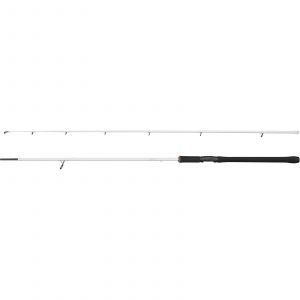
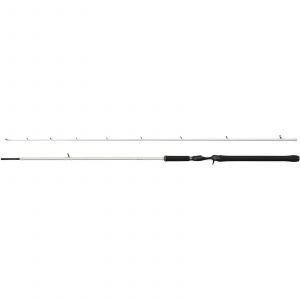
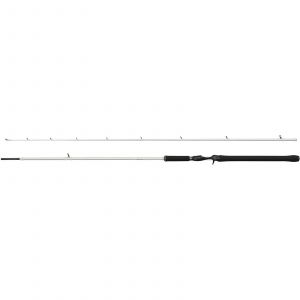
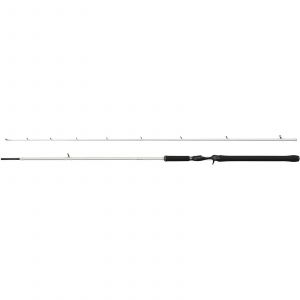
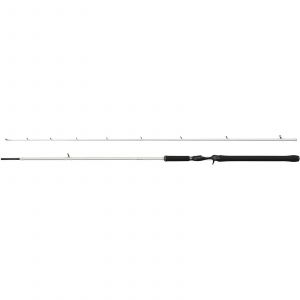
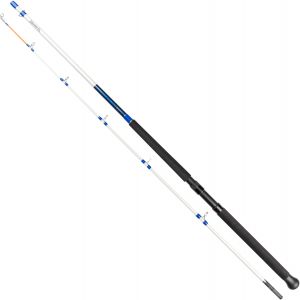
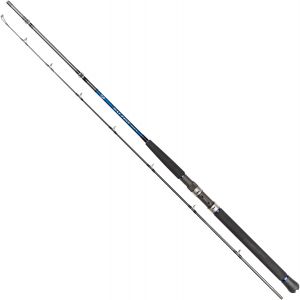
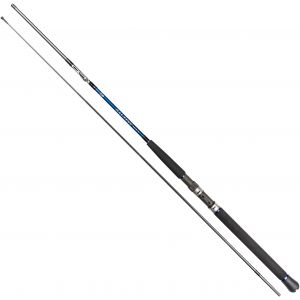
Time for trolling? Buy your gear here! Everything gathered on one page.
Trolling fishing involves dragging the baits behind the boat. A tried and tested method that covers a lot of water and various depths. The range in trolling fishing can be vast. It could be one rod and one bait behind a simple rowboat. Or 10-12 rods fished on downriggers and side planers from a top-equipped trolling boat in the million class. In principle, one can troll fish for all kinds of predatory fish, but primarily it involves salmon, trout, char, pike, and zander.
Dragging a couple of wobblers behind the boat in a smaller lake does not require any special equipment - possibly just a couple of rod holders and a simple fish finder. But if it concerns larger waters, then significantly more equipment is required. Special rods and reels, downriggers, side planers, trolling mast, rod holders, as well as fish finders and plotters are examples of gadgets included in the modern trolling fisherman's arsenal. Does it sound complicated? Ask us! We have the knowledge and the gadgets you need for your trolling fishing.
For regular fishing with a casting rod, you can easily group the lengths like this:
5-6 feet - Children/juniors 6-7 feet - Easy to handle - Perfect for boats. 7-9 feet - Most popular, especially for fishing from shore. 9+ feet - Coastal fishing and river fishing, etc.
Rod length
Refers to how many centimeters long the disassembled rod is. This can be good to know if you’re traveling or packing it into a motorcycle bag.
Rod length when transported
Refers to which type of fishing the product is intended for.
Example: A spinning reel is intended for the spin fishing method.
Type of fishing
Are you a beginner looking for a new rod? Check out the rods in the Medium and Medium-Fast categories. These rods bend a bit more than the so-called 'fast' rods, which simplifies both casting and fighting ability if a fish bites.
More about rod actions Action is a term for how the blank bends when pressure is applied to the tip and is described in English as follows:
Extra Fast (Ultra Fast): means the tip bends much more easily than the rest of the blank, which is relatively stiff.
Fast: bends just over a third of the blank.
Medium-Fast: bends about half of the blank.
Medium (Moderate): bends about 3/4 of the blank.
Slow: describes a parabolic bend of almost the entire blank.
Common simplified Swedish terms to describe action are tip-, half-, and full-action.
Different actions suit different fishing. 'Extra Fast' and 'Fast' provide more feel to the lure and faster hooksets, but the stiff blank reduces fighting ability and doesn’t offer the same 'slingshot effect' on casts as 'Medium' and 'Slow' actions.
Rod action
Refers to which type of rod this product pairs with. The most common rod types are spinning rods and casting rods. Casting rods pair with trolling reels, saltwater reels, low-profile reels, and baitcasting reels. Spinning rods pair with spinning reels.
Rod type
The weight class of a rod refers to how many kilos (kg) the rod can handle. The higher the number, the stronger the rod.
Weight class (kg)
The weight class refers to how powerful the rod is. The more pounds (lb) a rod is rated for, the stronger it is. A rod rated for 50 pounds (lb) can lift 22.7 kilos. 1 pound (lb) = 0.45359237 kg.
Trolling Fishing – Effective and Exciting Fishing on the Move
Trolling is a popular fishing method where lures are dragged behind a moving boat to target predatory fish such as salmon, trout, pike, and zander. This technique allows anglers to cover large areas of water, increasing the chances of finding actively feeding fish.
Successful trolling requires specialized equipment, including trolling rods, sturdy reels, and downriggers or paravanes to control lure depth. Choosing the right speed and lure presentation is crucial, as different species respond to varying speeds and depths.
The best trolling spots are often deep lakes, large rivers, or coastal waters where fish hunt in open water. Trolling is especially effective during seasonal fish migrations when predators actively follow baitfish schools.
Whether using artificial lures, wobblers, or live bait rigs, adapting to water temperature, depth, and weather conditions is key. Modern sonar and GPS technology help anglers locate fish and optimize trolling patterns for maximum success.
Trolling is an excellent choice for both beginners and experienced anglers seeking big catches. With the right setup and patience, this method can yield trophy fish and unforgettable fishing experiences.
Sign In
As a member, you get access to unique offers, prices & much more!
Create an Account
Join our membership club to receive extra discounts on fishing gear, advance access to promotions and much more. Completely free of charge!