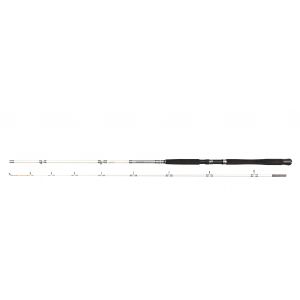
Here, we’ve marked which reel sizes are suitable for this specific rod. The type of reel to use with a rod depends on whether it’s a spinning, casting, saltwater, or similar rod, so if you’re unsure,feel free to double-check. That the same rod can have multiple reel sizes depends on the fishing style you’re pursuing.
Suitable reel size
Rod length grouped in feet + cm.
Are you a beginner and need guidance?
For regular fishing with a casting rod, you can easily group the lengths like this:
5-6 feet - Children/juniors 6-7 feet - Easy to handle - Perfect for boats. 7-9 feet - Most popular, especially for fishing from shore. 9+ feet - Coastal fishing and river fishing, etc.
Rod length
Refers to how many centimeters long the disassembled rod is. This can be good to know if you’re traveling or packing it into a motorcycle bag.
Rod length when transported
Are you a beginner looking for a new rod? Check out the rods in the Medium and Medium-Fast categories. These rods bend a bit more than the so-called 'fast' rods, which simplifies both casting and fighting ability if a fish bites.
More about rod actions Action is a term for how the blank bends when pressure is applied to the tip and is described in English as follows:
Extra Fast (Ultra Fast): means the tip bends much more easily than the rest of the blank, which is relatively stiff.
Fast: bends just over a third of the blank.
Medium-Fast: bends about half of the blank.
Medium (Moderate): bends about 3/4 of the blank.
Slow: describes a parabolic bend of almost the entire blank.
Common simplified Swedish terms to describe action are tip-, half-, and full-action.
Different actions suit different fishing. 'Extra Fast' and 'Fast' provide more feel to the lure and faster hooksets, but the stiff blank reduces fighting ability and doesn’t offer the same 'slingshot effect' on casts as 'Medium' and 'Slow' actions.
Rod action
Refers to which type of rod this product pairs with. The most common rod types are spinning rods and casting rods. Casting rods pair with trolling reels, saltwater reels, low-profile reels, and baitcasting reels. Spinning rods pair with spinning reels.
Rod type
The weight class of a rod refers to how many kilos (kg) the rod can handle. The higher the number, the stronger the rod.
Weight class (kg)
The weight class refers to how powerful the rod is. The more pounds (lb) a rod is rated for, the stronger it is. A rod rated for 50 pounds (lb) can lift 22.7 kilos. 1 pound (lb) = 0.45359237 kg.
Weight class (lb)
Here, we’ve categorized the products based on which fish you want to hook. We’ve relied on what manufacturers specify, but also on experience of what usually works. The list could almost be endless, and many things work for more species than we’ve listed, so don’t be afraid to experiment.
Salmon Fishing – The Ultimate Challenge for Anglers
Salmon fishing is one of the most exciting and rewarding experiences for any angler. These powerful fish are known for their strength, speed, and impressive acrobatics, making them a prized catch in both rivers and open water. Whether targeting wild salmon in fast-flowing rivers or trolling for large specimens at sea, salmon fishing requires skill, patience, and the right equipment.
Techniques for Salmon Fishing
There are several popular methods for catching salmon, including fly fishing, spin fishing, and trolling. Fly fishing is a favorite among river anglers, using specialized fly rods and artificial flies to imitate natural prey. Spin fishing with spoons, wobblers, or soft plastics is also effective, particularly in areas with strong currents. For those fishing in large lakes or the ocean, trolling with deep-diving lures or baitfish rigs is a proven technique for covering large areas and attracting big salmon.
Essential Gear for Salmon Fishing
A strong, medium to heavy-action rod suited for the fishing method and environment.
A high-quality spinning or baitcasting reel with a smooth drag system to handle long runs.
A braided or monofilament mainline, with a fluorocarbon leader for reduced visibility.
Lures such as spoons, wobblers, and soft plastics for spin fishing, or streamer flies for fly fishing.
A landing net and proper fish-handling tools for safely releasing or securing your catch.
Salmon fishing can be highly seasonal, with peak times depending on migration patterns and water conditions. Early mornings and late evenings are often the most productive times to fish. Patience and persistence are key
Sign In
As a member, you get access to unique offers, prices & much more!
Create an Account
Join our membership club to receive extra discounts on fishing gear, advance access to promotions and much more. Completely free of charge!